
Kardashev index
0.726
Based on primary energy power · Type I = 1

AccelerationFour-dimensional view8 years ago
GPT and BERT first learn from large amounts of unlabeled text and are then adapted to specific tasks, turning language models from specialized tools into reusable foundations.
Art style · Contemporary realistic technology illustration
Each sparkline shows the documented history of a metric on a logarithmic time axis. The dot marks the selected moment.
0.726
Based on primary energy power · Type I = 1
7.75Bpeople
1/1 of today
1.8×10¹³W
1/1 of today
3.5×10¹⁰floating-point operations per second per dollar (FLOP/s per $, nominal dollars)
1/2 of today
0.03 seconds
Comparable to today
39,897km/h
Comparable to today
The eight closest milestones. Select a title to jump there.
The paper "Attention Is All You Need" introduces the Transformer architecture. Source
The most powerful operational rocket makes its first flight, and its two side boosters land in sync. Source
OpenAI pretrains a language model on unlabeled text, then fine-tunes it for specific tasks. Source
Google's bidirectional pretrained model sets new records on many language understanding tasks. Source
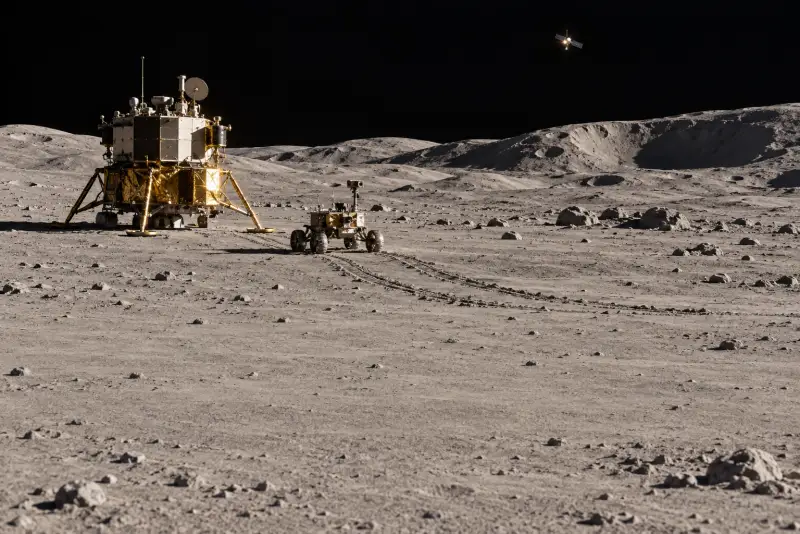
A spacecraft makes the first soft landing on the far side of the Moon. Source
A 1.5-billion-parameter model writes coherent long-form text; OpenAI releases it in stages. Source

The Event Horizon Telescope releases an image of the shadow of the M87 black hole. Source
Google's Sycamore processor outperforms classical supercomputers on a specific sampling task. Source
Acquired93 / 121 items
Each era illustrated in its own style.
Every timeline entry cites its source. Metrics interpolate logarithmically between sourced data points. Forecasts include institutional and community views, and attributed site scenarios; years are not guaranteed realization dates. Illustrations are AI-generated in each era's style.