
Kardashev index
—
No reliable data yet
AccelerationFour-dimensional view230 million years ago
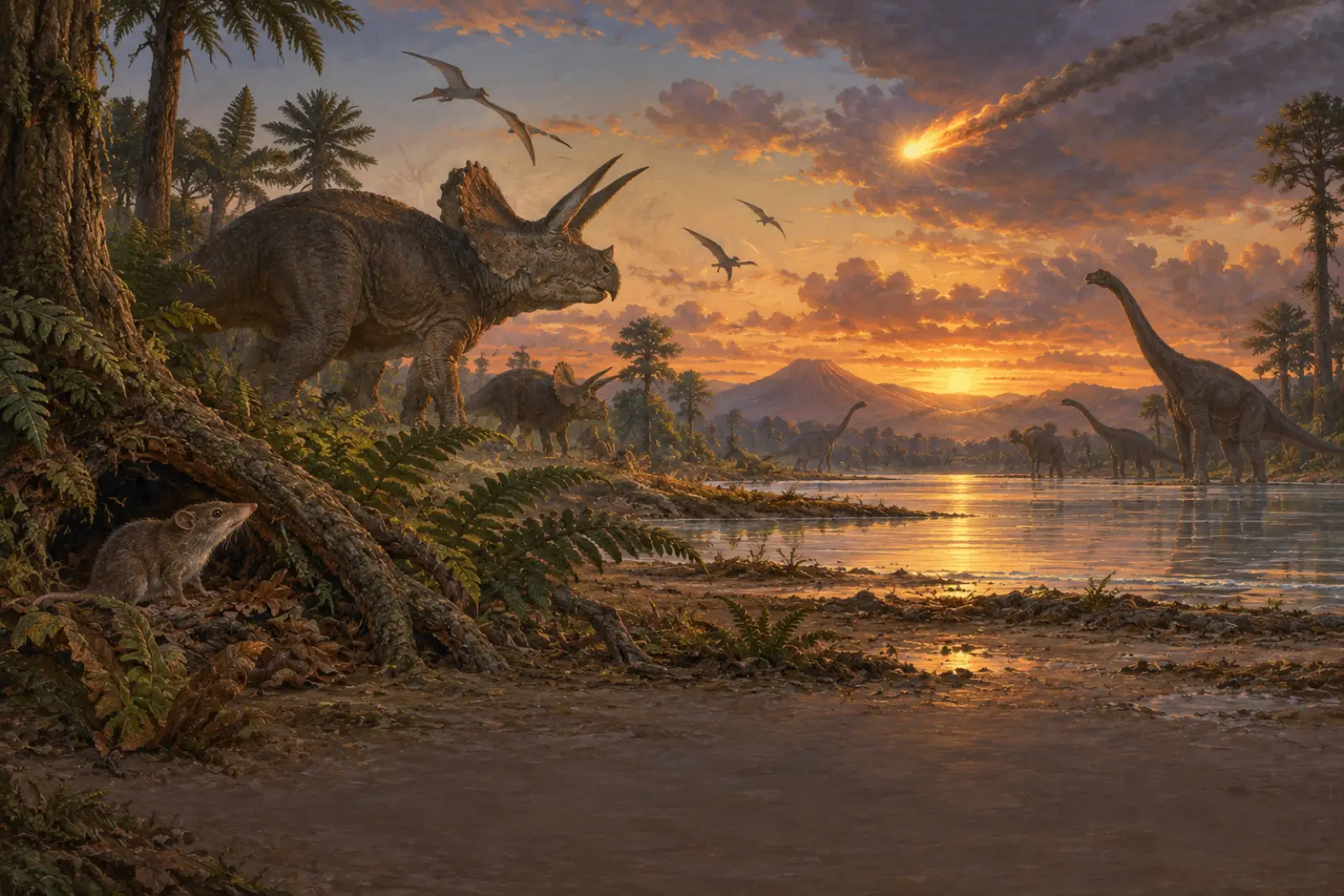
Dinosaurs rule the land for more than 100 million years; after an asteroid impact, mammals rise and primates appear.
Art style · Paleontological reconstruction oil painting
Each sparkline shows the documented history of a metric on a logarithmic time axis. The dot marks the selected moment.
—
No reliable data yet
—
No reliable data yet · data begins 12,000 years ago
—
No reliable data yet · data begins 12,000 years ago
—
No reliable data yet · data begins 1945
—
No reliable data yet · data begins 1620
—
No reliable data yet · data begins 302,000 years ago
The eight closest milestones. Select a title to jump there.
About 575 million years ago, early large multicellular organisms diversified on the seafloor. Source
Most modern animal phyla appeared within a geologically brief span of time. Source
Spore fossils of land plants appear in the Middle Ordovician, and the land begins to turn green. Source
Tiktaalik combined features of fish and tetrapods, showing vertebrates evolving toward life on land. Source
The most severe mass extinction in Earth's history wiped out most marine species. Source
Dinosaurs arose in the Late Triassic and went on to dominate the land for more than 100 million years. Source
Mammals evolved from cynodonts, with origins tracing back to the Late Triassic. Source
After an asteroid impact, the non-avian dinosaurs died out and mammals went on to flourish. Source
Acquired0 / 121 items
Humans have not yet appeared.
Each era illustrated in its own style.
Every timeline entry cites its source. Metrics interpolate logarithmically between sourced data points. Forecasts include institutional and community views, and attributed site scenarios; years are not guaranteed realization dates. Illustrations are AI-generated in each era's style.