
Kardashev index
—
No reliable data yet
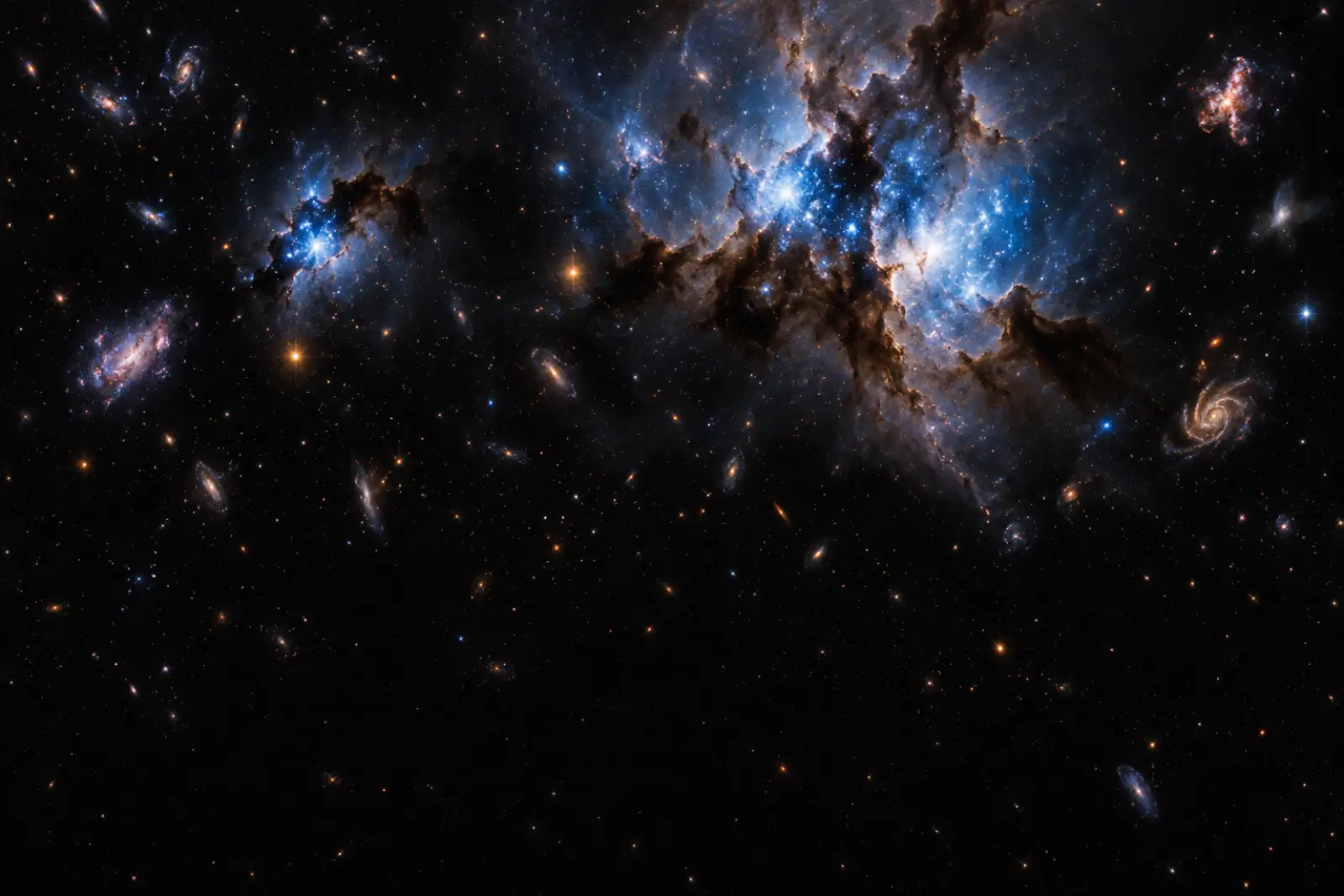
AccelerationFour-dimensional view13.69 billion years ago
The first stars ignite and forge heavy elements; galaxies gradually assemble, and the Milky Way begins to take shape.
Art style · Hubble Deep Field astrophotography
Each sparkline shows the documented history of a metric on a logarithmic time axis. The dot marks the selected moment.
—
No reliable data yet
—
No reliable data yet · data begins 12,000 years ago
—
No reliable data yet · data begins 12,000 years ago
—
No reliable data yet · data begins 1945
—
No reliable data yet · data begins 1620
—
No reliable data yet · data begins 302,000 years ago
The eight closest milestones. Select a title to jump there.
The universe began expanding from an extremely hot, dense state about 13.787 billion years ago. Source
About 380,000 years after the Big Bang, atoms formed and light began to travel freely, leaving behind the cosmic microwave background. Source
About 100 million years after the Big Bang, the first stars formed and forged heavier elements. Source
The seeds of the Milky Way appeared about 13.6 billion years ago, giving birth to its oldest stars. Source
About 4.568 billion years ago, a molecular cloud collapsed into the Sun and the disk of planets around it. Source
Earth accreted from material in the protoplanetary disk and is about 4.54 billion years old. Source
The leading hypothesis holds that a Mars-sized body struck the early Earth, and the debris coalesced into the Moon. Source
Stromatolites and other fossils show that life on Earth had appeared at least 3.5 billion years ago. Source
Acquired0 / 121 items
Humans have not yet appeared.
Each era illustrated in its own style.
Every timeline entry cites its source. Metrics interpolate logarithmically between sourced data points. Forecasts include institutional and community views, and attributed site scenarios; years are not guaranteed realization dates. Illustrations are AI-generated in each era's style.